
Why particle size comes down to mixing
From the conversations we have with our customers, one challenge comes back again and again: controlling particle size and keeping it consistent batch after batch.
It shows up everywhere fluids are involved: pharma, biotech, fine chemistry, nanoparticle synthesis and encapsulation, additive injection in plastics processing, and many more. In all of them, fast product development and reliable screening depend on one thing — understanding and controlling the fluidics.
Nucleation vs. growth: the competition that sets size
The physics is simple to state. Forming particles is a competition between two processes:
Nucleation — creating new particles
Growth — enlarging the ones already there
The balance between them sets both the average size and how uniform it is.
Why slow or pulsating mixing widens the distribution
To get a narrow, reproducible distribution, you want every particle to be born at the same instant and then grow together for the same length of time.
That synchronised nucleation only happens if the reagents reach a high, uniform supersaturation everywhere at the same moment, which means mixing them faster than the reaction itself. Fast, uniform mixing triggers the burst, consumes the supersaturation, and leaves little room for runaway growth → many small, uniform particles.
If mixing is slow or uneven, supersaturation builds up unevenly. Particles nucleate at different moments and in different spots; some keep growing in concentration-rich pockets while others stay small → a broad, polydisperse distribution.
This is why precise mixing within a very short residence time, and therefore small volumes, matters so much. And it is exactly why pulsation hurts: every pulse makes the local concentration swing inside the mixer, de-synchronising nucleation and smearing out the distribution (see the graph).
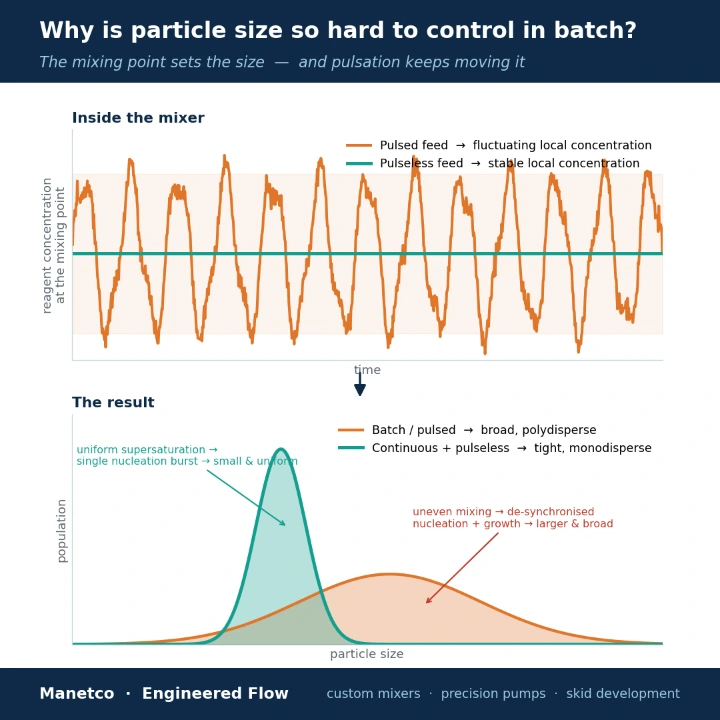
That is why these processes are so hard to run in batch. In continuous flow, with the right mixer geometry and pulseless, high-precision pumps, the local concentration stays under control — and so does your particle size.
How Manetco approaches it: mixer design and pulseless pumps
At Manetco, this is the kind of problem we solve with flow engineering: designing the right mixer, selecting the right pumps, and developing the skid around them.
Stuck on a flow process problem? Describe your challenge in a short message.